Reading Wednesday
Dec. 10th, 2014 02:48 pm![[personal profile]](https://www.dreamwidth.org/img/silk/identity/user.png) brigdh
brigdhWhat did you just finish?
Ran Away by Barbara Hambly.I love this book even more every time I read it. Structurally, the two mysteries are pretty separated, without much connecting them in terms of plot or clues, but I love how they echo each other thematically: the power of religion and particularly fanaticism of any sort; how money can constrain relationships; disguises and false names. I also really love how the flashback reawakens Ben's memories of Paris; throughout the series we've heard a lot about Ayasha's death and his grief, but this is the first time we've really seen his happiness there, and his day-to-day life. His dreams in the second half of the book are beautiful and heart-breaking, and the very last scene, the nighttime conversation between Ben and Rose, is basically my favorite thing ever in any canon. I'm just so happy to see their past pain acknowledged as real and lasting, without it diminishing their current happiness. I feel like it's rare for a piece of media to allow a character to love both his past and present partners deeply and meaningfully, without one needing to be his 'real' love or his 'true' love. I love that there's not a question of it being a competition for who is better; the issue isn't even raised. And that Rose's history still effects her, still is important, without it being the only thing she is. I just – the whole thing is so wonderful, so special, to me.
There's a lot of little things I like about this book, too. It was great to see past characters reappearing: Marguerite (though I wish we could have gotten more than one scene with her)! The Widow Redfern! Burton Blodgett (the journalist - he is horrible and yet I'm always so amused by him. I'd love him to be the main villain in a book someday)! I like that, three books after the decision was made, we finally get to see Ben and Rose actually participating in the Underground Railroad. I like the acknowledgement of how complicated it is to draw racial lines, that Huseyin is considered part of white society when he first arrives in New Orleans, but when he's in jail he goes to the cell for people of color. I really enjoy the Paris setting in this book, and would love to read more during that period – or fanfic! I also really want a Les Mis crossover, and this would totally be the book to use for it.
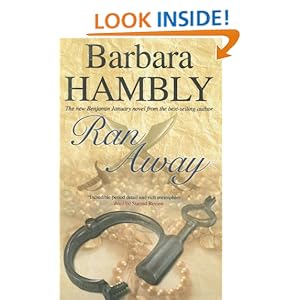
This is sort of a random note, but I hate the cover. I think it's ugly and doesn't at all convey the feel of the book - it sort of looks like something cheesy from Harlequin (Here's a link, if anyone hasn't seen it). I think the covers for the books published by Severn House are generally not as nice as the ones from Bantam Press (the first eight books are Bantam, Dead Water and everything before it; the ones since then are Severn House), but this is the worst one of them all, imho. I also think it's a bit suspicious that neither company has ever put a clear image of Ben himself on a cover - it's always a silhouette or a figure turned away or with the head cut off, or often just an inanimate object instead - but at least usually the cover manages to be pretty.
Some more things I liked:
‘Entia non sunt multiplicanda praeter necessitatem,’ he said after a moment’s thought. ‘The simplest explanation is best.’
‘The simplest explanation being that you cannot resist showing off your Latin?’
January grinned. ‘That, too.’
Ben is such a dork! It's adorable. :D Also, clearly he and Hannibal were destined to be friends - they both love to drop quotations.
‘If them curses was weapons,’ inquired old Uncle Bichet, and he sipped the beer Mr Trulove’s butler had provided for the musicians’ refreshment, ‘how come both those execrable shapes– like they called each other – wasn’t blasted out of their shoes then an’ there in the ballroom?’
‘They both missed,’ replied Hannibal at once. ‘Their aim was terrible.’
The whole rivalry between the preachers is hilarious to me. I really love this scene with everyone arguing about if their fight counts as a duel, but the later scene where the two preachers literally fist-fight over the Widow Redfern's affections is EVEN BETTER.
‘But speaking of Hannibal – and of hair...’ A frown clouded her forehead as she paused at the top of the steps. ‘Is there any condition that you know of – or any drug – that shows itself in a man’s hair? I know arsenic gets into the hair and makes it shiny; is there anything that will change the texture and make it limp and dead-looking?’ She looked up into his eyes for a moment, seeing in them, January knew, his own arrested look. ‘It isn’t my imagination, is it?’
NEVER OVER THIS CONVERSATION. I love that Ben and Rose are keeping such close watch over Hannibal. They care about one another so much, but they try not to show it. It is my absolutely favorite character type: passionate but pretending to be just sarcastic and witty.
Also, you know, the image of Hannibal dying his hair with henna is hilarious.
"I’m sure they won’t make a move until the house is actually broken into. Can’t arrest people for standing on the street corner, can you? Not whites, anyway."
Awww, Hannibal. Your awareness of New Orleans's racism has come along so far since the first book.
(And a link to the FFA discussion, long over.)
The Isolation Door by Anish Majumdar. Neil's mother, Priya, has schizophrenia, which has been mismanaged and currently has resulted in her being hospitalized; Neil's father is obsessed with Priya's treatment, which is part of why it's been poorly handled; Neil is starting theater school and wants to pretend that nothing else is happening. He quickly makes friends and starts a relationship, but is unable to tell them the truth about his family, to the extent of having his aunt pretend to be his mother.
This is one of those literary novels that is vaguely autobiographical (Majumdar's mother has schizophrenia and he was a theater student), which often seems to lead to a vagueness of plot and character. I suspect Majumdar was just too close to the subject matter to realize that he needed to explain some of its basic details. For instance, the plot centers around the family's money being controlled by a "public trustee" – but who is that? How much money are we talking about – the family doesn't seem unusually rich, but if you need a public trustee, I'd assume that they must be dealing with immense amounts. Whose money was it originally? It seems likely to have been Priya's, but how did she get it? How did it move out of her control? And why a "public trustee" (I'm not even sure what that is – a bank? a law firm?) and not another member of the family? When Neil suspects Priya is being abused in the hospital, he's unable to do anything about it because apparently her medical decisions are also being made by this public trustee – again, why? In what circumstances is the same legal structure in charge of someone's money and their health care? Even if Priya is required to be hospitalized, why couldn't Neil change hospitals? Argh, all of these things bugged me; I couldn't figure out what was going on most of the time, which meant characters' decisions and emotions held little weight, since I didn't know why they were doing anything or what the consequences would be. The style of writing was pretty, but there was nothing else to hold this story up.
I read this as an ARC via NetGalley.
Moby Dick by Herman Melville. Oh, this book. It has an excellent beginning – no, not "Call me Ishmael", though that's fine enough for a start, but I mean the rest of the opening paragraph:
Some years ago — never mind how long precisely — having little or no money in my purse, and nothing particular to interest me on shore, I thought I would sail about a little and see the watery part of the world. It is a way I have of driving off the spleen and regulating the circulation. Whenever I find myself growing grim about the mouth; whenever it is a damp, drizzly November in my soul; whenever I find myself involuntarily pausing before coffin warehouses, and bringing up the rear of every funeral I meet; and especially whenever my hypos get such an upper hand of me, that it requires a strong moral principle to prevent me from deliberately stepping into the street, and methodically knocking people's hats off — then, I account it high time to get to sea as soon as I can. This is my substitute for pistol and ball. With a philosophical flourish Cato throws himself upon his sword; I quietly take to the ship. There is nothing surprising in this. If they but knew it, almost all men in their degree, some time or other, cherish very nearly the same feelings towards the ocean with me.
YUP IT'S A VAGUELY SUICIDAL SNARKY NARRATOR. OF COURSE I'M INTO IT. And then by chapter three Ishmael has acquired aboyfriend husband (no, literally they describe themselves as married)(Also there's this bit: On the occasion in question, Queequeg figured in the Highland costume — a shirt and socks — in which to my eyes, at least, he appeared to uncommon advantage. HOW IS THAT LITERALLY NOT 'My husband is not wearing pants and looks hot'?) and if the entire book was just 'The Adventures of Ishmael and Queequeg, Sharing Beds and Going on Weird Tangents', I would love it. Ishmael has an excellent narrative voice; he can be lovely and thoughtful (Also, pretty blasphemous for 1851!):
In what census of living creatures, the dead of mankind are included; why it is that a universal proverb says of them, that they tell no tales, though containing more secrets than the Goodwin Sands; how it is that to his name who yesterday departed for the other world, we prefix so significant and infidel a word, and yet do not thus entitle him, if he but embarks for the remotest Indies of this living earth; why the Life Insurance Companies pay death-forfeitures upon immortals; in what eternal, unstirring paralysis, and deadly, hopeless trance, yet lies antique Adam who died sixty round centuries ago; how it is that we still refuse to be comforted for those who we nevertheless maintain are dwelling in unspeakable bliss; why all the living so strive to hush all the dead; wherefore but the rumor of a knocking in a tomb will terrify a whole city. All these things are not without their meanings.
But Faith, like a jackal, feeds among the tombs, and even from these dead doubts she gathers her most vital hope.
Or he can be sarcastic and hilarious. When describing a rich hypocrite: Yet Dives himself, he too lives like a Czar in an ice palace made of frozen sighs, and being a president of a temperance society, he only drinks the tepid tears of orphans.
Or listing what it takes to write a book: Oh, Time, Strength, Cash, and Patience!
Unfortunately, of course, the book is not really about Ishmael, and even less so Queequeg. Instead it's a whole thing about a whale and Captain Ahab and you all know this already. And as the story moves on, Ishmael and Queequeg drop more and more out of focus, until even his unique, entertaining first-person voice has faded away into a standard third-person omniscient. Melville does all sorts of weird stylistic experiments, from chapters written as sermons and encyclopedias, to chapters written as monologues and scenes from a play (complete with stage directions!) to the one chapter where it literally becomes a musical (AGAIN I'M NOT EXAGGERATING THIS IS A WEIRD-ASS BOOK). But none of it's as great as Ishmael in the first third or so of the book.
What are you currently reading?
Touched with Fire Christopher Datta. Another NetGallery novel, and another one that's turning out to disappoint my hopes.
Bombay Stories by Saadat Hasan Manto. Short stories set – guess where! :D
Ran Away by Barbara Hambly.
There's a lot of little things I like about this book, too. It was great to see past characters reappearing: Marguerite (though I wish we could have gotten more than one scene with her)! The Widow Redfern! Burton Blodgett (the journalist - he is horrible and yet I'm always so amused by him. I'd love him to be the main villain in a book someday)! I like that, three books after the decision was made, we finally get to see Ben and Rose actually participating in the Underground Railroad. I like the acknowledgement of how complicated it is to draw racial lines, that Huseyin is considered part of white society when he first arrives in New Orleans, but when he's in jail he goes to the cell for people of color. I really enjoy the Paris setting in this book, and would love to read more during that period – or fanfic! I also really want a Les Mis crossover, and this would totally be the book to use for it.
This is sort of a random note, but I hate the cover. I think it's ugly and doesn't at all convey the feel of the book - it sort of looks like something cheesy from Harlequin (Here's a link, if anyone hasn't seen it). I think the covers for the books published by Severn House are generally not as nice as the ones from Bantam Press (the first eight books are Bantam, Dead Water and everything before it; the ones since then are Severn House), but this is the worst one of them all, imho. I also think it's a bit suspicious that neither company has ever put a clear image of Ben himself on a cover - it's always a silhouette or a figure turned away or with the head cut off, or often just an inanimate object instead - but at least usually the cover manages to be pretty.
Some more things I liked:
‘Entia non sunt multiplicanda praeter necessitatem,’ he said after a moment’s thought. ‘The simplest explanation is best.’
‘The simplest explanation being that you cannot resist showing off your Latin?’
January grinned. ‘That, too.’
Ben is such a dork! It's adorable. :D Also, clearly he and Hannibal were destined to be friends - they both love to drop quotations.
‘If them curses was weapons,’ inquired old Uncle Bichet, and he sipped the beer Mr Trulove’s butler had provided for the musicians’ refreshment, ‘how come both those execrable shapes– like they called each other – wasn’t blasted out of their shoes then an’ there in the ballroom?’
‘They both missed,’ replied Hannibal at once. ‘Their aim was terrible.’
The whole rivalry between the preachers is hilarious to me. I really love this scene with everyone arguing about if their fight counts as a duel, but the later scene where the two preachers literally fist-fight over the Widow Redfern's affections is EVEN BETTER.
‘But speaking of Hannibal – and of hair...’ A frown clouded her forehead as she paused at the top of the steps. ‘Is there any condition that you know of – or any drug – that shows itself in a man’s hair? I know arsenic gets into the hair and makes it shiny; is there anything that will change the texture and make it limp and dead-looking?’ She looked up into his eyes for a moment, seeing in them, January knew, his own arrested look. ‘It isn’t my imagination, is it?’
NEVER OVER THIS CONVERSATION. I love that Ben and Rose are keeping such close watch over Hannibal. They care about one another so much, but they try not to show it. It is my absolutely favorite character type: passionate but pretending to be just sarcastic and witty.
Also, you know, the image of Hannibal dying his hair with henna is hilarious.
"I’m sure they won’t make a move until the house is actually broken into. Can’t arrest people for standing on the street corner, can you? Not whites, anyway."
Awww, Hannibal. Your awareness of New Orleans's racism has come along so far since the first book.
(And a link to the FFA discussion, long over.)
The Isolation Door by Anish Majumdar. Neil's mother, Priya, has schizophrenia, which has been mismanaged and currently has resulted in her being hospitalized; Neil's father is obsessed with Priya's treatment, which is part of why it's been poorly handled; Neil is starting theater school and wants to pretend that nothing else is happening. He quickly makes friends and starts a relationship, but is unable to tell them the truth about his family, to the extent of having his aunt pretend to be his mother.
This is one of those literary novels that is vaguely autobiographical (Majumdar's mother has schizophrenia and he was a theater student), which often seems to lead to a vagueness of plot and character. I suspect Majumdar was just too close to the subject matter to realize that he needed to explain some of its basic details. For instance, the plot centers around the family's money being controlled by a "public trustee" – but who is that? How much money are we talking about – the family doesn't seem unusually rich, but if you need a public trustee, I'd assume that they must be dealing with immense amounts. Whose money was it originally? It seems likely to have been Priya's, but how did she get it? How did it move out of her control? And why a "public trustee" (I'm not even sure what that is – a bank? a law firm?) and not another member of the family? When Neil suspects Priya is being abused in the hospital, he's unable to do anything about it because apparently her medical decisions are also being made by this public trustee – again, why? In what circumstances is the same legal structure in charge of someone's money and their health care? Even if Priya is required to be hospitalized, why couldn't Neil change hospitals? Argh, all of these things bugged me; I couldn't figure out what was going on most of the time, which meant characters' decisions and emotions held little weight, since I didn't know why they were doing anything or what the consequences would be. The style of writing was pretty, but there was nothing else to hold this story up.
I read this as an ARC via NetGalley.
Moby Dick by Herman Melville. Oh, this book. It has an excellent beginning – no, not "Call me Ishmael", though that's fine enough for a start, but I mean the rest of the opening paragraph:
Some years ago — never mind how long precisely — having little or no money in my purse, and nothing particular to interest me on shore, I thought I would sail about a little and see the watery part of the world. It is a way I have of driving off the spleen and regulating the circulation. Whenever I find myself growing grim about the mouth; whenever it is a damp, drizzly November in my soul; whenever I find myself involuntarily pausing before coffin warehouses, and bringing up the rear of every funeral I meet; and especially whenever my hypos get such an upper hand of me, that it requires a strong moral principle to prevent me from deliberately stepping into the street, and methodically knocking people's hats off — then, I account it high time to get to sea as soon as I can. This is my substitute for pistol and ball. With a philosophical flourish Cato throws himself upon his sword; I quietly take to the ship. There is nothing surprising in this. If they but knew it, almost all men in their degree, some time or other, cherish very nearly the same feelings towards the ocean with me.
YUP IT'S A VAGUELY SUICIDAL SNARKY NARRATOR. OF COURSE I'M INTO IT. And then by chapter three Ishmael has acquired a
In what census of living creatures, the dead of mankind are included; why it is that a universal proverb says of them, that they tell no tales, though containing more secrets than the Goodwin Sands; how it is that to his name who yesterday departed for the other world, we prefix so significant and infidel a word, and yet do not thus entitle him, if he but embarks for the remotest Indies of this living earth; why the Life Insurance Companies pay death-forfeitures upon immortals; in what eternal, unstirring paralysis, and deadly, hopeless trance, yet lies antique Adam who died sixty round centuries ago; how it is that we still refuse to be comforted for those who we nevertheless maintain are dwelling in unspeakable bliss; why all the living so strive to hush all the dead; wherefore but the rumor of a knocking in a tomb will terrify a whole city. All these things are not without their meanings.
But Faith, like a jackal, feeds among the tombs, and even from these dead doubts she gathers her most vital hope.
Or he can be sarcastic and hilarious. When describing a rich hypocrite: Yet Dives himself, he too lives like a Czar in an ice palace made of frozen sighs, and being a president of a temperance society, he only drinks the tepid tears of orphans.
Or listing what it takes to write a book: Oh, Time, Strength, Cash, and Patience!
Unfortunately, of course, the book is not really about Ishmael, and even less so Queequeg. Instead it's a whole thing about a whale and Captain Ahab and you all know this already. And as the story moves on, Ishmael and Queequeg drop more and more out of focus, until even his unique, entertaining first-person voice has faded away into a standard third-person omniscient. Melville does all sorts of weird stylistic experiments, from chapters written as sermons and encyclopedias, to chapters written as monologues and scenes from a play (complete with stage directions!) to the one chapter where it literally becomes a musical (AGAIN I'M NOT EXAGGERATING THIS IS A WEIRD-ASS BOOK). But none of it's as great as Ishmael in the first third or so of the book.
What are you currently reading?
Touched with Fire Christopher Datta. Another NetGallery novel, and another one that's turning out to disappoint my hopes.
Bombay Stories by Saadat Hasan Manto. Short stories set – guess where! :D


![[identity profile]](https://www.dreamwidth.org/img/silk/identity/openid.png)
no subject
Date: 2014-12-10 10:19 pm (UTC)no subject
Date: 2014-12-12 07:28 pm (UTC)no subject
Date: 2014-12-10 10:20 pm (UTC)That's why I would like to see Moby Dick adapted as a one-man show: Ishmael making lists, doing the voices, getting distracted by whaling trivia and Queequeg, trying and failing to convey the epic scale of the Great Sperm-Squeezing -- it's easy enough to make a straightforward whale-death-adventure out of it, but I think it would be fun to see an adaptation try to capture some of the weird energy of the narrative voice.
(swinging by from the friending meme -- hi!)
no subject
Date: 2014-12-12 07:48 pm (UTC)That's a really interesting idea! I'd like to see that too. Most of the adaptions I'm aware of really focus on Ahab, and it would be so cool to see something that's closer to the weird stylistic experiment of the book.
(Hi! :D New people are always welcome.)
SURPRISE I love Moby Dick
Date: 2014-12-10 11:47 pm (UTC)I have so many things I could say it's hard to be coherent. I love how even in the middle of outdated whale information it still spits out gems like "I promise nothing complete; because any human thing supposed to be complete, must for that very reason infallibly be faulty." Ugggggh.
I love Ishmael and Queequeg so much. I love how Ishmael goes from "AUGH HE'S SCARY" to "WTF is wrong with me and my dumb biases" and all the marital allusions dfgdsgsdgf. I've never looked for a spin-off or adaptation that makes it all about Ishmael and Queequeg but now I want it.
Now I want to reread it so badly. I'm so happy my high school teacher had us read it. (She picked out all the infodump chapters and had us skip them, save 2 people who read it and did a brief summary for the rest. Smart move.)
Man now I want to reread it.
no subject
Date: 2014-12-12 07:36 pm (UTC)no subject
Date: 2014-12-11 03:46 pm (UTC)My ex, twenty years ago, was reading it for fun and plopped down beside me and said, 'This is my favorite book. How about I read you some?' and I must have raised both eyebrows sky-high, because he said, 'No, no, you'll love it! It's funny and strange. Besides, the main character marries another man!'
'Oh, he does not,' I said. 'Don't be absurd.'
And then he read me some. Eventually, I shrieked, 'They just got married!'
'Told you,' he said, smug.
And thus, I read the whole thing, and reader, I was enchanted. Except towards the later part, which had too much Ahab and not enough Queequeg, obvs.
no subject
Date: 2014-12-12 07:31 pm (UTC)